
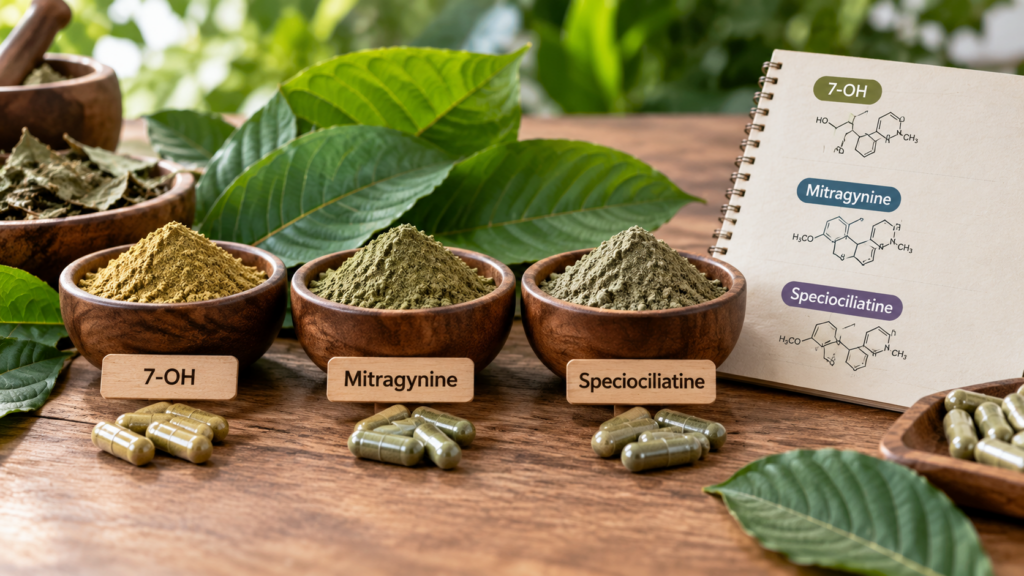
Kratom is often discussed as if it were a single substance, but the leaf contains dozens of related compounds called alkaloids, and product labels now name them individually. That shift has left a lot of readers comparing terms they have never had to think about before: a pack of nano tech mitragynine tablets lists mitragynine, while most chewable tablets list 7-OH. The most common comparison is mitragynine vs 7oh, but speciociliatine and a handful of lab-derived compounds also turn up in labels, lab reports and news coverage. This guide explains what each one is, how they relate to each other, and why the difference now matters for labeling and the law.
Kratom Is a Mixture, Not a Single Compound
Mitragyna speciosa is a tropical tree in the coffee family, native to Southeast Asia. Researchers have identified a large number of alkaloids in its leaves. Most occur only in small amounts, and the exact profile varies with the region the leaf was grown in, the age of the leaf and how it was dried and processed.
A handful of names come up again and again:
• Mitragynine, the main alkaloid in most leaf samples
• 7-hydroxymitragynine (7-OH), a minor alkaloid that attracts most of the regulatory attention
• Speciociliatine, speciogynine and paynantheine, which are close chemical relatives of mitragynine
• Mitraphylline, an oxindole alkaloid that is also found in some other plants of the same family
Understanding mitragynine, 7-OH and speciociliatine covers most of what readers need to know.
Mitragynine: The Main Alkaloid in the Leaf
Mitragynine is the most abundant alkaloid in most kratom leaf, and it is the compound people usually mean when they talk about traditional kratom. On product packaging it is often shortened to "MIT."
Published laboratory research describes mitragynine as interacting with several receptor systems in the body, including opioid receptors, where it is generally characterized as a partial agonist. It has been studied far more than most other kratom alkaloids, although the research base in people is still limited.
From a legal point of view, mitragynine is not covered by the 2026 federal scheduling actions, which is relevant to how MIT-labeled products are positioned. Some brands now sell both kinds of product: searches for stax mitragynine lead to a range that includes 7-OH tablets alongside a separate MIT tablet. State law can still restrict kratom and its alkaloids, so federal status is not the whole story.
7-Hydroxymitragynine: A Minor Alkaloid With Major Attention
7-OH is present in the natural leaf only in small amounts. Laboratory and animal research also indicates that some mitragynine can be converted to 7-OH by liver enzymes. In laboratory studies, 7-OH binds more strongly to the mu-opioid receptor than mitragynine does, which is one reason regulators have given for treating concentrated 7-OH products differently from the leaf.
The products that drew regulatory action are not leaf products. They are concentrated formats in which 7-OH is present at levels far above anything found naturally. In July 2025 the FDA recommended scheduling these concentrated products, and in July 2026 the DEA published a notice of intent to temporarily place 7-OH above a specified threshold in Schedule I. As of early October 2026, that order had not been published.
Speciociliatine: A Close Relative of Mitragynine
Speciociliatine is one of the less familiar names, but it turns up on detailed lab reports and in educational material, so readers searching speciociliatine vs 7oh are usually trying to work out whether the two are related. The short answer is that speciociliatine is much closer to mitragynine than to 7-OH.
Chemically, speciociliatine is a diastereomer of mitragynine. That means the two molecules share the same formula and the same connections between atoms, but differ in the three-dimensional arrangement at one or more points. Small differences in shape like this can change how a molecule behaves, which is why researchers study these isomers separately.
Speciociliatine is a minor alkaloid in the leaf and has been studied much less than mitragynine or 7-OH. It is not named in the 2026 federal scheduling actions. If you see it listed on a certificate of analysis, it usually reflects the natural alkaloid profile of the leaf material used.
The Lab-Derived Compounds: MP, MGM-15 and MGM-16
Three other names entered the conversation in 2026: mitragynine pseudoindoxyl (MP), MGM-15 and MGM-16. These are not simply leaf alkaloids that happen to be present in larger amounts. They are lab-derived compounds related to 7-OH.
On August 26, 2026, the DEA placed all three in Schedule I on a temporary basis, effective immediately. Products containing them can no longer be sold legally, and reputable retailers have removed them. It is worth keeping these compounds separate in your mind from mitragynine and speciociliatine, which are natural leaf alkaloids and are not covered by that order.
How Labels Describe Alkaloids
The alkaloid names above now drive how products are labeled. A few patterns are worth knowing.
"MIT" products state an amount of mitragynine. For example, the 7Stax Nano Tech Mitragynine Tablets list 80mg of mitragynine per tablet and 400mg per five-tablet pack. Terms like "nano" describe the manufacturer's processing. Any claims about absorption or onset are the manufacturer's own and have not been evaluated by the FDA.
"7-OH" products state an amount of 7-hydroxymitragynine per tablet, per serving or per bottle. For example, roxy 7-oh tablets in a 30-count bottle list 20mg per tablet and 600mg per bottle. These are the products affected by the pending federal order.
"Extract" or "full spectrum" products often state milligrams of leaf extract rather than milligrams of any single alkaloid. A tablet listing 300mg of extract does not contain 300mg of mitragynine. The extract is a mixture, and only a lab report shows how much of each alkaloid it holds.
Proprietary blends list a branded complex with a total weight. They may not break down the individual compounds at all, which makes the lab report even more important.
Reading a Certificate of Analysis
A certificate of analysis, or COA, is the most reliable way to see what is actually in a batch. When you look at one, check for the following:
1. A batch or lot number that matches the product packaging.
2. The testing laboratory's name and, ideally, its accreditation. ISO/IEC 17025 accreditation is a common benchmark for testing labs.
3. An alkaloid panel that lists mitragynine, 7-OH and, in more detailed reports, minor alkaloids such as speciociliatine.
4. The test method, usually a form of liquid chromatography, which can separate closely related compounds like mitragynine and its isomers.
5. Contaminant testing for heavy metals and microbes, which applies to every botanical product regardless of alkaloid content.
A COA that does not match the batch in hand, or that leaves out the alkaloid panel entirely, tells you very little.
Federal Status at a Glance
• Kratom leaf: not covered by the 2026 federal orders
• Mitragynine: not covered by the 2026 federal orders
• Speciociliatine: not covered by the 2026 federal orders
• 7-OH above the proposed threshold: proposed for temporary Schedule I control, not yet published as of early October 2026
• MP, MGM-15 and MGM-16: temporarily in Schedule I since August 26, 2026
State and local rules can be stricter than any of these federal positions, so always check where you live.
Frequently Asked Questions
Is 7-OH the same as mitragynine?
No. They are different alkaloids. 7-OH is found in small amounts in the leaf and can also be formed from mitragynine during metabolism, but the two compounds behave differently and are treated differently by regulators.
Is speciociliatine a form of 7-OH?
No. Speciociliatine is a diastereomer of mitragynine, not of 7-OH. It is a natural minor alkaloid and is not named in the federal scheduling actions.
Why are so many products now labeled "MIT"?
Mitragynine sits outside the 2026 federal orders, which is relevant to how MIT-labeled products are positioned while the 7-OH order remains pending. That is a regulatory point, not evidence that the products are equivalent.
What should I check before relying on a label?
Match the batch number to a current COA from an independent lab, and look for a full alkaloid panel rather than a single headline number.