
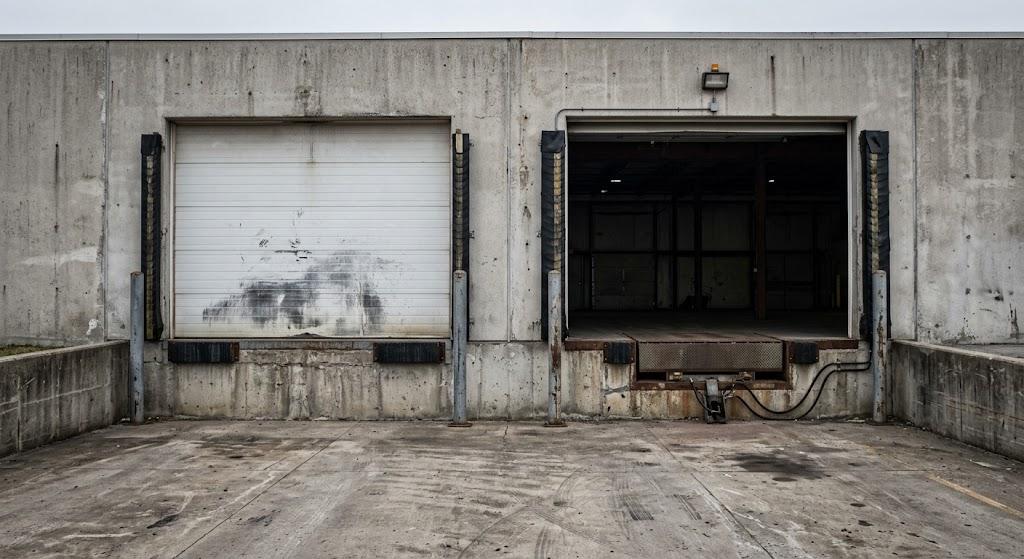
A residential garage door runs perhaps 1,500 cycles a year. A loading dock door at a busy distribution site can run that in a month. Same basic engineering, completely different duty cycle, and a maintenance approach borrowed from the residential world will not survive contact with it.
Here is what actually differs about commercial doors and what a maintenance program needs to cover.
The Door Types
Sectional overhead doors are the commercial version of what most houses have: horizontal sections running on tracks, counterbalanced by torsion springs. Heavier gauge, larger, often insulated, and available in high-lift and vertical-lift configurations for buildings with the ceiling height to use them.
Rolling steel doors coil into a barrel above the opening rather than running back along the ceiling. They suit openings where there is no ceiling room for horizontal tracks, they are extremely durable, and they are the standard for warehouses, storage facilities and service bays.
High-speed doors open and close in seconds rather than tens of seconds. They exist because cycle time is money in a temperature-controlled or high-traffic environment, and because slow doors get hit by forklifts.
Fire-rated doors are held open by a fusible link or an electronic release and close automatically when heat is detected. These carry legal inspection requirements distinct from ordinary maintenance.
And dock equipment, levelers, seals, shelters and bumpers, sits alongside the doors and shares their failure modes.
Why They Fail Faster
Cycle count is the obvious factor, and springs are rated in cycles rather than years. A standard residential spring is good for around 10,000 cycles. A commercial door running 100 cycles a day reaches that inside four months, which is why commercial specifications routinely call for 50,000 to 100,000 cycle springs.
Impact is the second factor and it is specific to commercial sites. Forklifts, pallet jacks, delivery vehicles and reversing trucks hit doors. The damage is rarely catastrophic on its own, but a slightly bent track or a distorted bottom section shifts the load path, and everything downstream wears faster.
Operator error is the third. A residential door is used by four people who all know it. A commercial door is used by a rotating cast under time pressure, some of whom will run a forklift at a door that has not finished opening.
And environmental exposure. Dust, wash-down water, refrigeration humidity, salt in coastal facilities, and continuous temperature differentials across the door plane all accelerate wear on bearings, seals and springs.
What Downtime Actually Costs
This is the calculation that justifies a maintenance program, and it is worth doing honestly.
A stuck dock door stops inbound and outbound freight. Drivers wait, appointments are missed, and downstream deliveries slip. In a temperature-controlled facility a door stuck open is a product loss issue within hours. In a secure facility a door stuck open is a security issue immediately.
Against those numbers, the cost of a scheduled maintenance program is generally a rounding error. The businesses that skip it are usually the ones that have never sat down and calculated what one failed door on a Monday morning actually costs them.
What a Maintenance Program Should Include
A proper program for commercial garage door services is more than a lubrication visit. It should cover, at a defined interval based on cycle count rather than the calendar:
Spring condition and remaining cycle life, with replacement scheduled before failure rather than after. On high-cycle doors this is the single most valuable item in the program, because a planned spring change is a scheduled thirty minutes and an unplanned one is a stopped dock.
Cable inspection end to end, checking for fraying, corrosion and even tension, with replacement in matched pairs.
Roller, bearing, hinge and track condition, including checking that track brackets are secure into the structure.
Operator inspection: motor, drive, limit switches, force settings, and the electrical connections, which vibrate loose in a high-cycle environment.
Safety systems: photo eyes, reversing edges, and any safety edge or light curtain fitted. On a commercial door these protect employees, which brings a regulatory dimension that residential doors do not have.
Weather seals and bottom astragals, which affect energy cost and, in food or pharmaceutical facilities, pest control compliance.
And documentation. A maintenance log per door, with cycle counts where available, is what turns reactive repair into predictable replacement planning.
Fire Doors Are Separate
Fire-rated rolling doors carry their own inspection and drop-test requirements under NFPA standards, typically annually, and they must be tested by a qualified party with the results documented.
This is not something to fold casually into general maintenance. It is a distinct obligation, it is checked by inspectors, and a facility that cannot produce the records has a compliance problem regardless of whether the doors work.
Setting the Interval
The mistake most facilities make is scheduling by calendar. Twice a year is a residential cadence and it is meaningless on a door running 200 cycles a day.
Set the interval by cycle count where the operator can report it, or by measured duty where it cannot. A low-use door on a rarely-used bay might genuinely be annual. A primary dock door might need quarterly attention. Treating them identically means over-servicing one and under-servicing the other, which is the worst of both outcomes.